
October 17, 2025
How do you choose the right pneumatic cylinder?
A pneumatic cylinder uses compressed air to move something. This can be a linear motion (back and forth), as with a standard air cylinder, or a rotational motion. There are different types of cylinders: There are different types of cylinders:
- Single-acting: the cylinder moves in one direction using compressed air; a spring or gravity returns the cylinder to its home position.
- Double-acting: The cylinder uses air on both sides of the piston to enable controlled movement in two directions.
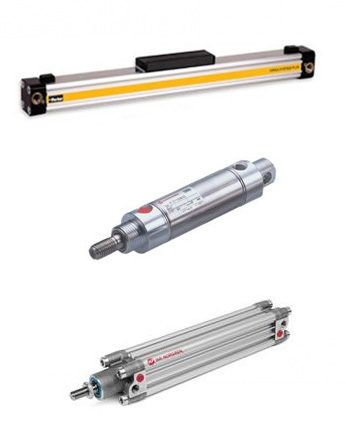
- Rodless cylinders; this cylinder also uses air on both sides and has no tie rod, but rather a guide. The cylinder is ideal for applications with limited space or long stroke lengths.
1. Required Force
How heavy is the load you want to move? The force of a pneumatic cylinder is determined by the air pressure and the diameter of the piston. It’s better to calculate a slightly higher force to prevent the cylinder from failing under peak loads.
2. Stroke Length and Speed
The stroke length is the distance the cylinder must travel. The faster or longer the stroke, the more important it is to choose the right damping and valves. Make sure the air flow rate is large enough to achieve the desired speed.
3. Available space
Space is limited in many machines. A rodless cylinder can be the perfect solution in such cases: compact, with a long stroke without increasing the cylinder’s overall length.
4. The operating environment
Will the cylinder be used in a damp, dusty, or chemical environment? If so, choose materials and seals that can withstand these conditions, such as stainless steel or coated aluminum cylinders.
5. Control
Some applications work fine with simple on/off control. But if you need precise positioning, choose cylinders with sensors or magnetic feedback. There are even integrated solutions where valves and sensors are already built in.
6. Maintenance and service life
A well-chosen cylinder means less downtime. Therefore, pay attention to ease of maintenance: how easy is it to replace seals, and how wear-resistant are the materials? A durable cylinder pays for itself.
Practical examples
- Limited space, long stroke: choose a rodless cylinder.
- Simple back-and-forth motion: a single-acting cylinder is usually sufficient.
- Dirty or damp environments: Use stainless steel cylinders with sturdy seals.
Choose pneumatic cylinders from IMI Norgren Parker
Choose the high quality of IMI Norgren Parker it comes to pneumatic cylinders.
View our selection of pneumatic cylindershere.